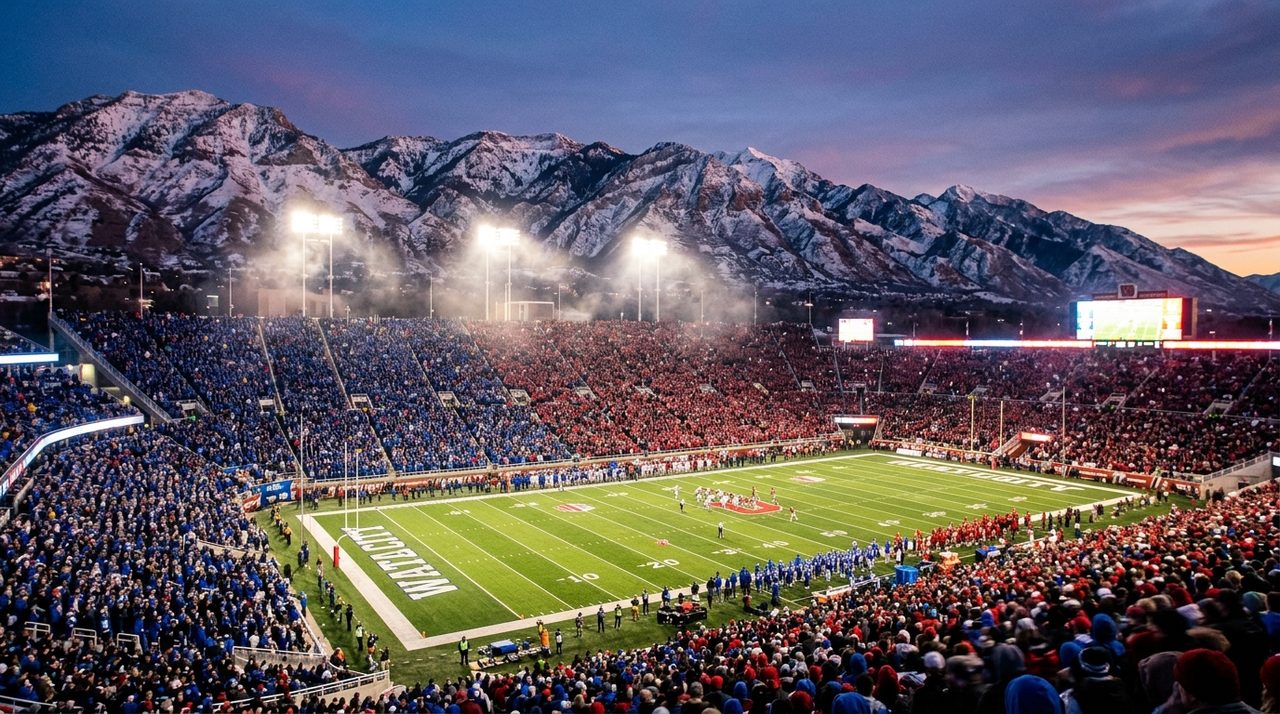
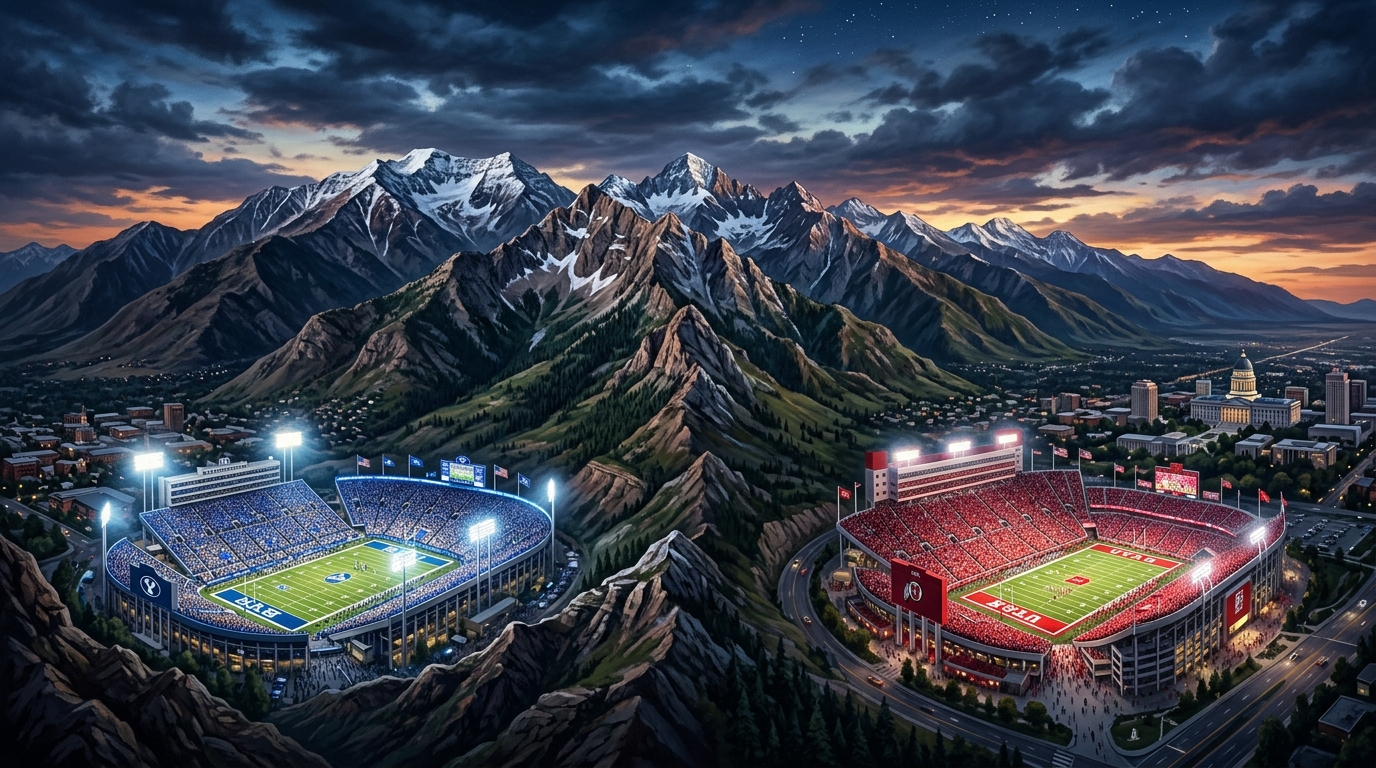
NEXT CLASH: NOV 7, 2026 • RICE-ECCLES STADIUM
Big 12 Conference • Kalani Sitake vs. Morgan Scalley
Choose Side:
Two Record Books, One Bitter Rivalry: Utah counts 103 games (62–37–4). BYU counts 97 (59–34–4).
Provo • Royal Blue50 Miles on I-15Salt Lake City • Crimson
Fifty Miles of Asphalt. Over a Century of College Football Lore.
Welcome to the independent historical and statistical archive of the BYU vs. Utah "Holy War". Built for diehard Cougars and Utes alike, this archive documents every game since 1896, unpacks why the two schools disagree on the all-time series count, and chronicles the fourth-quarter miracles that define autumn along the Wasatch Front.
The Record Dispute
Who Really Leads The Holy War?
Showing Utah Record Book (1896–2025 • Includes 6 BYA games split 3–3)
Since 2005, no rivalry in FBS football has produced tighter fourth-quarter drama. Thirteen of the last 17 meetings have finished within 8 points—including two overtime classics (2005, 2009), walk-off touchdowns (2006, 2009), blocked kicks at 0:00 (2010, 2012), a 1-point goal-line stand (2016), and back-to-back Big 12 thrillers in 2024 (22–21) and 2025 (24–21).
Want live Big 12 gameday debate or deeper situational EPA film study? Join the fan threads on CougarCorner.com or explore red-zone efficiency models on CFBGameGuru.com.
Pendulum of Power
Series Wins by Decade (1890s–2020s)
Notice how the rivalry swung from Utah's 1920s–1960s dominance to BYU's 1970s–1980s air raid era, Utah's 2010s streak, and BYU's 2020s surge.
Rivalry Primer & Key Facts
Frequently Asked Questions About The Holy War
Why is the BYU–Utah rivalry called "The Holy War"?
Coined by local Utah sports radio hosts in the 1990s (and popularized nationally during the high-stakes 2003–2008 Mountain West title clashes), the nickname reflects the institutional contrast between Brigham Young University (owned and operated by the Church of Jesus Christ of Latter-day Saints in Provo) and the University of Utah (the state's flagship public secular university in Salt Lake City).
Why do BYU and Utah list different all-time series records?
Utah counts six games played between 1896 and 1898 against Brigham Young Academy (BYA), which were split 3–3, giving Utah a 62–37–4 lead across 103 games. BYU only counts games played after it became a university and reinstated varsity football in 1922, yielding a 59–34–4 Utah lead across 97 games.
What happened in the 2024 and 2025 Big 12 matchups?
After reuniting as Big 12 Conference members in 2024, BYU won back-to-back thrillers: a 22–21 walk-off win in Salt Lake City on November 9, 2024 (Will Ferrin's 44-yard field goal with 4 seconds left), followed by a 24–21 victory in Provo on October 18, 2025 capped by Bear Bachmeier's 22-yard fourth-quarter touchdown run.
When is the 2026 Holy War football game?
The 2026 Big 12 showdown is scheduled for Saturday, November 7, 2026 at Rice-Eccles Stadium in Salt Lake City. It marks the first Holy War coaching duel between BYU's Kalani Sitake and new Utah head coach Morgan Scalley, who succeeded Kyle Whittingham in December 2025.
Chronological Retrospective (1896–2026)
Six Eras of the Holy War
Very few college football rivalries have experienced dramatic pendulum swings like BYU and Utah. What began as a lopsided pre-1972 regional series evolved into a national passing laboratory in the 1970s and 1980s, a BCS-busting gauntlet in the 2000s, a Pac-12 vs. Independence chess match in the 2010s, and a marquee Big 12 conference battle today.
Era I • 1896–1898Era Series: Tied 3–3 (6 Games)
The Brigham Young Academy Years & The Disputed Origin
Even the birth date of the rivalry is fiercely contested. According to the University of Utah record book, the series began on April 6, 1896, when Utah defeated Brigham Young Academy (BYA) 12–4 in Salt Lake City. Over three seasons from 1896 to 1898, Utah and BYA met six times, splitting those contests 3–3 (including a 22–0 BYA shutout in Provo in December 1897). When BYA disbanded football in 1900 and didn't field a varsity team as Brigham Young University until 1922, BYU's official record book chose to begin its count in 1922.
Era II • 1922–1971Era Series: Utah Leads 38–5–4 (47 Games)
Fifty Years of Crimson Dominance & The 1942 Breakthrough
When BYU reinstated varsity football on October 14, 1922, Utah delivered a 49–0 shutout in Salt Lake City—still Utah's largest margin of victory in the series. Under legendary Hall of Fame coach Ike Armstrong (who went 18–1–3 against BYU from 1925 to 1949), Utah put together a 21-game unbeaten streak before Eddie Kimball's Cougars stunned the Utes 12–7 on October 10, 1942. Aside from a three-game BYU win streak behind quarterback Virgil Carter from 1965 to 1967, Utah dominated the Rocky Mountain, Skyline, and early WAC eras, holding an overwhelming 41–8–4 all-time advantage through 1971.
Era III • 1972–2000Era Series: BYU Leads 22–7 (29 Games)
The LaVell Edwards Passing Revolution & Ron McBride's Counterpunch
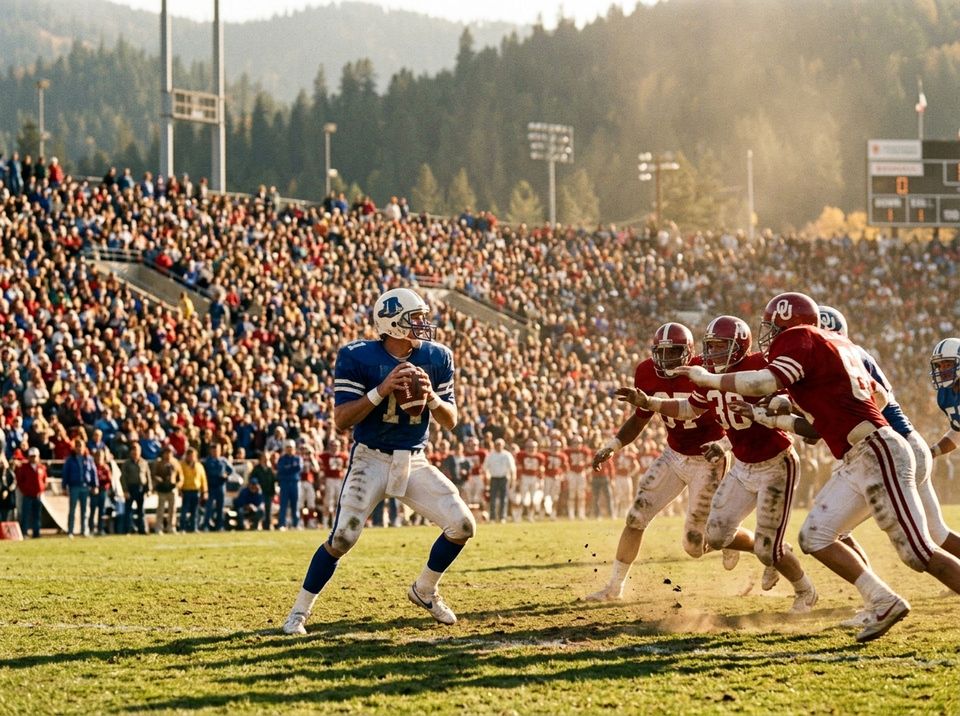
Everything changed in 1972 when BYU promoted assistant coach LaVell Edwards. Installing a revolutionary West Coast passing attack, Edwards beat Utah 16–7 in his debut and went an astonishing 19–2 from 1972 to 1992. Along the way, Marc Wilson threw for an NCAA-record 571 yards in 1977, Jim McMahon pointed to the 56–6 scoreboard in 1980, Robbie Bosco led BYU past Utah en route to the 1984 National Championship, and Ty Detmer engineered a 70–31 shootout in 1989. You can explore detailed profiles of Edwards, McMahon, Young, and Detmer at CougarLegend.com and CougarHeroes.com.
In 1990, Utah hired fiery head coach Ron McBride, who turned the rivalry into a war of equals. Beginning with Chris Yergensen's 55-yard game-winning field goal in Provo in 1993 (34–31), seven of the final eight meetings of Edwards' career were decided by single digits, culminating in Brandon Doman's last-minute drive to give Edwards a 34–27 win in his 2000 finale.
Era IV • 2001–2010Era Series: Utah Leads 6–4 (10 Games)
Mountain West Title Wars, BCS Busters & Beck-to-Harline
During the Mountain West Conference decade, the road to the conference trophy—and national BCS bowls—ran straight through November's rivalry clash. Urban Meyer arrived in Salt Lake City in 2003, dubbing BYU "The Team Down South," snapping BYU's NCAA-record 361-game scoring streak in a snowy 3–0 win in Provo, and routing BYU 52–21 in 2004 behind Alex Smith to become the original BCS Busters.
When Kyle Whittingham and Bronco Mendenhall took over their respective programs in 2005, they produced arguably the greatest coaching rivalry of the decade: 2005's 41–34 overtime shootout, 2006's walk-off "Beck to Harline" miracle (33–31), 2007's 4th-and-18 conversion from Hall to Collie (17–10), Utah's 2008 undefeated Sugar Bowl springboard (48–24), 2009's overtime walk-off to Andrew George (26–23), and Brandon Burton's blocked kick at the horn in 2010 (17–16).
Era V • 2011–2023Era Series: Utah Leads 8–1 (9 Games)
The Realignment Divide: Pac-12 Membership vs. FBS Independence
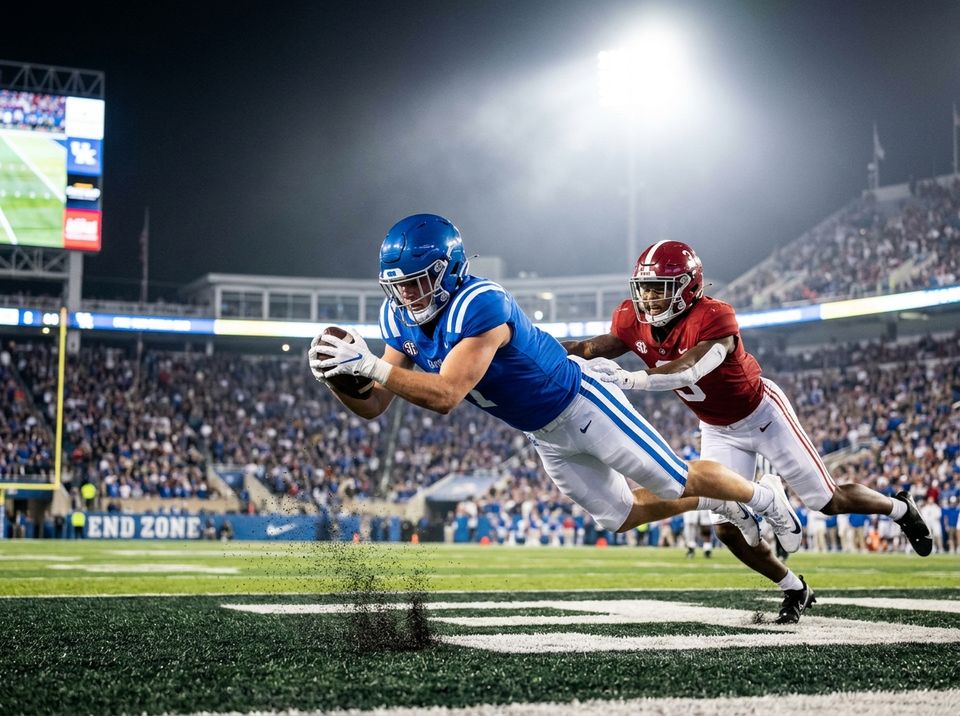
In 2011, Utah joined the Pac-12 Conference while BYU charted a bold course as an FBS Independent (a scheduling and media-rights strategy analyzed in depth at FootballIndependents.com). Now played primarily in September as a non-conference showdown, Kyle Whittingham's Utes reeled off eight wins in this era—extending an overall 9-game winning streak from 2010 to 2019 that featured the triple-field-storm 2012 finish (24–21), the 2015 Las Vegas Bowl (35–28), the 2016 one-point goal-line stand (20–19), and a 20-point second-half comeback in 2018 (35–27). On September 11, 2021, Kalani Sitake and QB Jaren Hall finally shattered the 3,941-day streak with a 26–17 victory in Provo.
Era VI • 2024–PresentEra Series: BYU Leads 2–0 (Big 12 Era)
Reunited in the Big 12 & The Sitake vs. Scalley Chapter
Conference realignment brought the rivals back under the same league banner in 2024 as members of the expanded Big 12 Conference. In the inaugural Big 12 clash on November 9, 2024, No. 9 BYU silenced a record Rice-Eccles Stadium crowd of 54,383 with a late 65-yard drive and Will Ferrin's 44-yard field goal with 4 seconds left (22–21). On October 18, 2025, No. 15 BYU made it three straight over No. 23 Utah in Provo (24–21) behind freshman quarterback Bear Bachmeier's fourth-quarter heroics. Following Kyle Whittingham's retirement in December 2025, longtime defensive coordinator Morgan Scalley now leads the Utes into the November 7, 2026 showdown in Salt Lake City.
Complete Verified Game Log (1896–2025)
Interactive All-Time Series Database
Filter all 103 meetings by decade, winner, stadium, or game margin—or toggle between the 1896 Utah ledger and 1922 BYU varsity ledger.
#
Date
Winner
Score
Location
Classification
Historical Game Note
Sideline Generals
Notable Head Coaches in Holy War History
Head Coach
Program
Tenure
Rivalry Record
Win %
Legacy & Defining Moments
Legendary Finishes & Unfiltered Quotes
Crazy Finishes & Famous Quotes
In the Holy War, throw out the rankings and watch the final two minutes. From Chris Yergensen's 55-yard bomb in 1993 and John Beck's walk-off strike to Jonny Harline in 2006, to Utah's 28-point rally in 2018 and BYU's 2024/2025 Big 12 finishes, explore the 17 most unforgettable games and the unfiltered quotes that fueled the fire.
Straight from the Sidelines
Famous Holy War Quotes (1977–Present)
The Hardware & Gameday Lore
Trophies, Traditions & Trivia
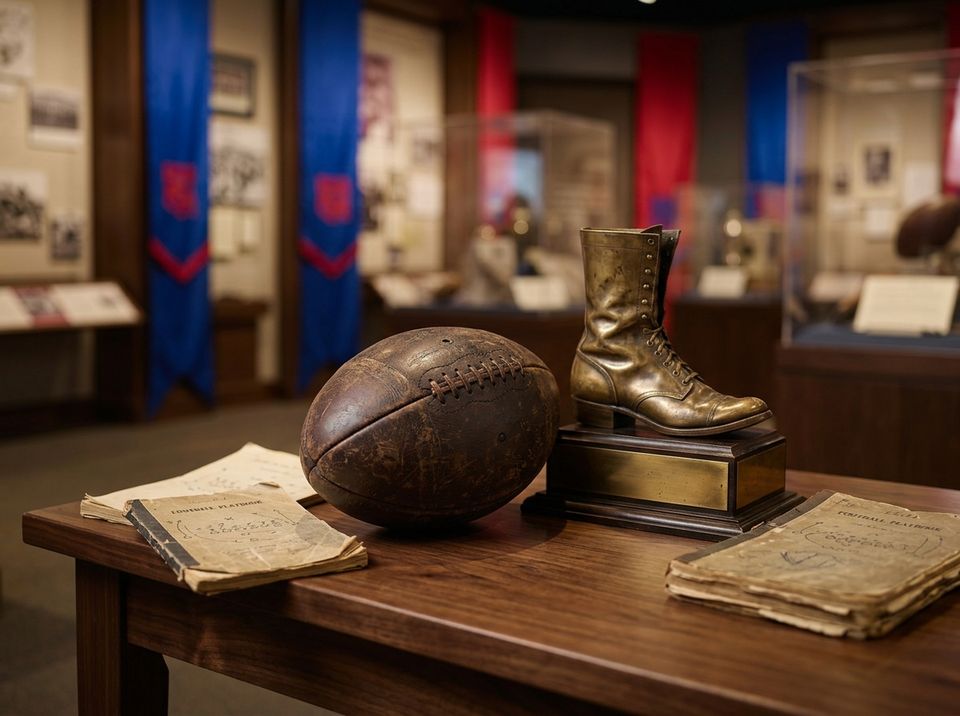
From the bronze pioneer Beehive Boot crafted from an authentic 19th-century Mormon pioneer boot to the color-on-color spectacle of Royal Blue against Crimson Red, the Holy War is steeped in pageantry unique to the Intermountain West.
Since 1971 • In-State Supremacy
The Beehive Boot Trophy
Created in 1971, the Beehive Boot is one of college football's oldest three-way state trophies, contested among BYU, Utah, and Utah State. Cast from a genuine 100-year-old pioneer buffalo-hide boot, it has been hoisted 25 times by BYU, 16 times by Utah, and 10 times by Utah State.
Royal Blue vs. Crimson Red
Color-Rush Uniform Tradition
Following NCAA rules allowing both teams to wear home dark jerseys when colors contrast sharply, the Holy War regularly features a vibrant visual clash: BYU in iconic Royal Blue (explored in detail at RoyalBlueCougars.com) against Utah's all-Crimson look and hand-painted throwback helmets.
MUSS vs. The ROC
3rd-Down Jump & Fight Songs
At Rice-Eccles Stadium, the Mighty Utah Student Section (MUSS) locks arms for "Utah Man" and the deafening 3rd-Down Jump. Fifty miles south in Provo, the Roaring Of Cougars (ROC) student section belts out the Loyal, Strong and True Cougar Fight Song beneath the snow-dusted peaks of Y Mountain.
Test Your Rivalry IQ
The Holy War Trivia Challenge
Score: 0 / 8
Curated Beehive State Football & Rivalry Reading
Where to Go Next: Community Forums, Film Study & Regional Lore
Each sister publication below covers a specialized slice of Wasatch Front athletics—from live gameday fan boards and advanced EPA analytics to historical player halls of fame.
Primary Fan Hub & Analytics
Gameday Discussion & Film Study
CougarCorner.com ↗ — Active BYU Cougars fan community, Big 12 recruiting threads, and postgame reaction boards.
CFBGameGuru.com ↗ — Advanced college football matchup analytics, situational red-zone efficiency, and Big 12 film breakdowns.
FootballIndependents.com ↗ — Scheduling logistics and media strategy from BYU's 2011–2022 independent run.
All-Time Icons & Heritage
Legends, Jerseys & Fight Songs
CougarLegend.com ↗ — Archival profiles of LaVell Edwards, retired numbers, and Hall of Fame milestones.
AlwaysACougar.com ↗ — Multi-generational alumni traditions and family gameday stories.
Wasatch Front Culture & Banter
Regional Rivalry & Tailgate Humor
UtahRedHawks.com ↗ & UtahHawks.com ↗ — Intermountain high school prep pipelines, altitude training advantages, and Wasatch Front sports culture.
UtahFanAmI.com ↗ — Commentary on the cultural divide and friendly friction across Beehive State households.
UtesSuck.com ↗ — Unfiltered partisan BYU tailgate memes and gameday ribbing for royal-blue superfans.
Rivalry Moniker Deep-Dive
BYU (Provo)
vs.
Utah (Salt Lake City)
Why Is It Called "The Holy War"?
Forty-five miles along the Wasatch Front, private religious devotion clashes with public state pride in one of college football's fiercest cultural divides.
⚡
The Definitive Answer
The Core Meaning Behind the Moniker
The BYU vs. Utah football rivalry is called the "Holy War" because it pits Brigham Young University—a private church university owned and operated by The Church of Jesus Christ of Latter-day Saints (LDS)—against the University of Utah—the state's flagship secular, public institution. Separated by only 45 miles along Utah's Wasatch Front, the moniker captures a deep-seated clash between church culture and state identity that permeates families, workplaces, and neighborhoods across the Beehive State.
45 MilesCampus Distance (I-15)
1896First Gridiron Meeting
Church vs. StateInstitutional Divide
103+ GamesAll-Time Series
The 4 Foundations
Why This Rivalry Cuts Deeper Than Football
Unlike standard state-line rivalries, the Holy War is fueled by four interlocking factors of faith, geography, media lore, and divided households.
01
Cultural Demographics
Church vs. State Dynamic
Brigham Young University in Provo is sponsored by the global LDS Church; its students and faculty adhere to an ecclesiastical Honor Code prohibiting alcohol, tobacco, and caffeine abuse. In contrast, the University of Utah in Salt Lake City is a secular Tier-1 public research institution representing the broader, cosmopolitan diversity of the state capital. The matchup has long represented a cultural referendum between Utah County's conservative LDS tradition and Salt Lake's urban secularism.
BYU: Faith & Honor CodeUtah: Secular Public Flagship
02
Media & Broadcaster History
Origins of the "Holy War" Tag
The label "Holy War" was popularized by local sports columnists in The Salt Lake Tribune and Deseret News in the late 1960s and 1970s. As LaVell Edwards turned BYU into a national powerhouse and the Western Athletic Conference (WAC) titles went through the Wasatch Front, national broadcasters like Keith Jackson, Brent Musburger, and ESPN embraced the moniker. While other rivalries (like Notre Dame vs. Boston College) have religious overtones, BYU–Utah is recognized universally simply as The Holy War.
First Coined: 1960s–70s PressNationalized by ESPN & ABC
03
Unmatched Proximity
The "Split Living Room" Reality
Unlike rivalries separated by state borders (like Ohio State–Michigan or Oklahoma–Texas), BYU and Utah fans live in the exact same neighborhoods, attend the same church congregations, and share the same family dinner tables. In hundreds of thousands of Utah homes, one spouse graduated from BYU and the other from Utah. Sibling rivalries play out on living room rugs, and the loser faces 365 days of inescapable teasing from coworkers, in-laws, and neighbors.
Shared CommunitiesYear-Round Bragging Rights
04
The Moniker Controversy
Attempts to Rebrand vs. Fan Passion
Over the decades, university administrators and church leaders have periodically expressed unease with the term, particularly following the September 11 terrorist attacks. Officials pushed alternatives like the "Deseret Duel" or "Beehive Battle" to soften the rhetoric. Yet fans, players, and national networks consistently rejected the sterile rebrands. The raw passion and palpable electricity between these two institutions make "The Holy War" an irrepressible piece of American sports lore.
Corporate Rebrands FailedEmbraced by Modern Fans
The Great Historical Paradox
Did Brigham Young Found Both Schools?
In one of the most delightful ironies in college sports, Brigham Young was the founder of both universities!
On February 28, 1850, as governor of the provisional State of Deseret, Brigham Young chartered the University of Deseret in Salt Lake City—which was later renamed the University of Utah in 1892. Twenty-five years later, on October 16, 1875, Young deeded land in Provo to create Brigham Young Academy, which formally became Brigham Young University in 1903.
Thus, Utah is actually the older institution by a quarter-century, while BYU bears the founder's literal name—giving both fanbases a valid historical claim to the pioneer prophet's legacy!
1850 • University of DeseretChartered by Brigham Young in Salt Lake City → Became University of Utah (1892)
1875 • Brigham Young AcademyDeeded by Brigham Young in Provo → Became Brigham Young University (1903)
Authentic Rivalry Venom
Voices of the Holy War
Coaches and players who lived on the front lines describe what makes this battle so deeply personal.
Max Hall
BYU Quarterback (2007–2009)
"I don't like Utah. In fact, I hate them. I hate everything about them. I hate their program, their fans. I hate everything... It felt good to beat them."
"There is no game like this one. It's intense, it's personal, and everybody has a stake in it. It transcends football in this state."
BYU Alumnus (1982) & Utah Head Coach (11-5 in Holy War)
LaVell Edwards
BYU Hall of Fame Coach (1972–2000)
"When I played at Utah, BYU was a breath of fresh air—an automatic win. Turning that around made it the bitterest game in the West."
Utah Alumnus (1952) & BYU Head Coach (22-7 vs. Utah)
National Context
The Holy War vs. America's Greatest Rivalries
How the BYU–Utah clash compares across proximity, cultural divide, and frequency.
Rivalry
Teams
Campus Distance
Primary Tension
First Played
Series Leader
The Holy War
BYU vs. Utah
45 Miles
Private Church vs. Secular Public Flagship
1896
Utah (62–37–4 / 59–34–4)
Catholic Clash
Notre Dame vs. Boston College
850 Miles
Catholic Institutional Hegemony
1975
Notre Dame (17–9)
The Iron Bowl
Alabama vs. Auburn
155 Miles
Flagship University vs. Land-Grant Agricultural
1893
Alabama (50–37–1)
The Game
Ohio State vs. Michigan
185 Miles
Interstate Border Dispute (Toledo War)
1897
Michigan (61–51–6)
America's Game
Army vs. Navy
220 Miles
Military Service Branch Honor
1890
Navy (62–55–7)
Interactive Fan Poll
What Is Your Stance on the "Holy War" Name?
Cast your vote below — your choice is saved instantly.
1,012+ Verified Votes
Love the "Holy War" Moniker77% (784)
Acceptable Football Tradition14% (142)
Prefer "BYU–Utah Classic"9% (86)
Search Engine FAQ
Frequently Asked Questions
Common questions searchers ask about the Holy War moniker, religious ties, and rivalry history.
The rivalry is called the "Holy War" because it pits Brigham Young University—a private institution owned and operated by The Church of Jesus Christ of Latter-day Saints (LDS)—against the University of Utah, the state's flagship secular public university. Separated by only 45 miles along Utah's Wasatch Front, the name reflects the intense cultural, religious, and institutional contrast between church and state that divides families, workplaces, and neighborhoods across Utah.
Yes! In one of college sports' greatest historical ironies, Brigham Young founded the University of Deseret (which became the University of Utah) in 1850, and 25 years later in 1875 founded Brigham Young Academy (which became BYU). Both schools trace their roots back to the exact same pioneer leader.
The moniker was popularized by local sports journalists in Salt Lake City newspapers (The Salt Lake Tribune and Deseret News) during the late 1960s and 1970s as the rivalry intensified during the LaVell Edwards era. National networks like ABC and ESPN then elevated it to nationwide recognition.
No. The University of Utah is a secular, state-supported public research university with no religious affiliation, in contrast to BYU which is owned and operated by the LDS Church and adheres to an ecclesiastical Honor Code.
The teams compete for the Beehive Boot, established in 1971. The trophy is an authentic, cast-bronze 100-year-old pioneer buffalo-hide boot awarded annually to the champion of the three-way in-state rivalry among BYU, Utah, and Utah State.
Both BYU and Utah compete in the Big 12 Conference. After spending 2011–2023 in separate conferences (Utah in the Pac-12, BYU as an independent and later joining the Big 12 in 2023), Utah joined the Big 12 in 2024, officially reuniting the rivalry as an annual in-conference showdown.